Portrait
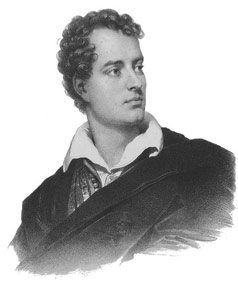
George Gordon, Lord Byron (1788-1824) was tall, dark, handsome, and brilliant. He was also born into one of the great aristocratic families of England and inherited the title at age ten. He had everything that one needed to become a great hero of the Romantic Movement including the necessary physical flaw that added to his glamour: he had a club foot. In 1824, he died in the middle of helping to lead the Greek revolution to liberate the nation from Turkish enslavement. His death struck down the most famous Romantic poet of the age at the exact moment of his greatest fame. It was the perfect Romantic end.
Chronology
| 1788 | Byron born 22 January in London. |
|---|---|
| 1790 | Taken by his mother to Aberdeen, Scotland. |
| 1791 | Death of his father, Captain John Byron, in France. |
| 1793 | Enters his first school, in Aberdeen. |
| 1794-95 | Attends Aberdeen Grammar School. In 1794, on the death of his great uncle, becomes heir to the title, Baron Byron of Rochdale. |
| 1798 | Is made Lord Byron. Moves with his mother to Newstead Abbey, ancestral home of the Byrons. |
| 1801-05 | Attends Harrow School. In 1803 falls in love with Mary Chaworth, his neighbor at Newstead. (The attachment ends when he overhears Mary laugh to her maid, "What! Me care for that lame boy!") . |
| 1805 | Enters Trinity College, Cambridge. |
| 1806 | First volume of poems, Fugitive Pieces, privately printed. Upon the Reverend John Beecher's objections to certain of the poems, Byron withdraws the volume. |
| 1807 | Poems on Various Occasions, an expurgated version of Fugitive Pieces, privately printed. Later in the year the volume appears in a public printing as Hours of Idleness. On March 13, Byron takes his seat in the House of Lords. |
| 1808 | Hours of Idleness is the subject of scathing critique in The Edinburgh Review. On July 4 Byron receives his A.M. degree from Cambridge. |
| 1809 | Publication of English Bards and Scotch Reviewers. On July 2, sails from Falmouth for Lisbon with John Cam Hobhouse. Travels through Portugal, Spain, Malta, and Albania, reaching Athens at the end of the year. Writes the first Canto of "Childe Burun" (later Childe Harold's Pilgrimage). |
| 1810 | Travels through Greece and Turkey. On May 3 swims the Hellespont from Sestos to Abydos. Writes the second canto of "Childe Burun." |
| 1811 | Returns to England July 14. Death of Byron's mother and of the Cambridge chorister John Edleston ("Thyrza"). |
| 1812 | Delivers speeches in the House of Lords. Childe Harold, Cantos I and II, published in March. First meeting with his wife-to-be, Annabella Milbanke. Affair with Lady Caroline Lamb. Affair with Lady Oxford. |
| 1813 | Publication of The Giaour (June) and The Bride of Abydos (December). |
| 1813 | Publication of The Corsair (January) and Lara (August). Becomes engaged to Annabella Milbanke. |
| 1815 | Marries Annabella on January 2. Publication of Hebrew Melodies. Daughter, Augusta Ada, born to Annabella on December 10. |
| 1816 | Byron's wife leaves him in January. The Siege of Corinth and Parisina are published in February. In April the separation from his wife is formalized. Byron leaves England forever on April 24. Arriving in Geneva, he befriends Percy and Mary Shelley and Claire Clairmont, spends the summer with them, and has an affair with Claire. Travels to Venice, has an affair with Marianna Segati, his landlord's wife. At the end of the year, Childe Harold Canto III and The Prisoner of Chillon are published. |
| 1817 | Daughter, Allegra, born to Claire Clairmont on January 12. Byron travels to Rome with Hobhouse, returns to settle in Venice. Affair with Margarita Cogni, wife of a Venetian baker. Sells Newstead Abbey. Manfred published in June. |
| 1818 | Beppo (satire in the ottava rima of Don Juan) published in February. The Shelleys come to Italy and are with Byron from March to November. Childe Harold Canto IV published in April. Allegra comes to Venice. |
| 1819 | Beginning of affair with Countess Teresa Guiccioli. Mazeppa published in June, Don Juan Cantos I and II in July. Moves to Ravenna at the end of the year to be near Teresa. |
| 1820 | Lives in the Guiccioli palace with his daughter Allegra. Becomes involved in the Carbonari movement, the Italian revolution against Austrian rule. Official separation between Teresa and her husband in July. |
| 1821 | Teresa's family, the Gambas, are banished to Pisa after the defeat of the Carbonari movement; Byron moves there with them. Marino Faliero published in April, Don Juan Cantos III-V in August, Cain, The Two Foscari, and Sardanapalus in December. Byron promises Teresa to discontinue Don Juan |
| 1822 | Allegra dies in April. Leigh Hunt moves to Byron's house in June, where they collaborate on the journal The Liberal. Shelley is drowned July 8 in his boat, the Don Juan. The Vision of Judgment appears in The Liberal in October. |
| 1823 | Don Juan Cantos VI-XIV published. Byron sails for Greece, arriving at Missolonghi on December 30. |
| 1824 | Catches a chill in the rain on April 9. Dies at Missolonghi on April 19.BYRON COMES HOME TO ENGLAND |
| June 29 | Ship The Florida brings body to estuary Thames. |
| July 5 | Hobhouse goes aboard and brings body up the Thames to London.On board finds Byron's precious dog Lion, big black Newfoundland at the foot of the coffin never leaving his master. Hobhouse almost breaks down. In London, Dean of Westminster will not allow burial of Byron in Westminster Abbey. Take body to home of one of the lords where lies in state for several days. Thousands file past. Sir Edward Knatchbull at 20 Great George Street. |
| July 10 | Set out from London for journey to Nottinghamshire for burial in family crypt near Newstead Abbey.In Nottinghamshire more thousands file past bier. |
| July 16 | Morning at 8:00 AM
Mourners led by Hobhouse journey to little church of
St Mary Magdalene, Hucknall Torkard (near Newstead).
Hobhouse the dearest friend there.
Augusta did not come. Her husband Colonel Leigh did.
	       IN THE VAULT BENEATH

WHERE MANY OF HIS ANCESTORS AND HIS MOTHER ARE BURIED

                LIE THE REMAINS OF

             GEORGE GORDON NOEL BYRON

              LORD BYRON, OF ROCHDALE

            IN THE COUNTY OF LANCASTER

      THE AUTHOR OF CHILDE HAROLD'S PILGRIMAGE.

            HE WAS BORN IN LONDON ON THE

               22nd OF JANUARY 1788

  HE DIED AT MISSOLONGHI, IN WESTERN GREECE ON THE

                19th OF APRIL 1824

  ENGAGED IN THE GLORIOUS ATTEMPT TO RESTORE THAT

     COUNTRY TO HER ANCIENT FREEDOM AND RENOWN

             HIS SISTER, THE HONORABLE

                AUGUSTA MARY LEIGH

          PLACED THIS TABLET TO HIS MEMORY.
|
Poetry
Byron’s Poetry
I Wish I Were a Careless Child (1806)
Written After Swimming from Sestos to Abydos (1810)
The Destruction of Sennacherib (1815)
Links
Bibliography
Lord Byron Bibliography
Biographies
Eisler, Benita. Byron, Child of Passion, Fool of Fame.
New York: Alfred Knopf, 1999. Now available in a paperback edition: Vintage books, (May, 2000, $18.00). This is the latest, best biography of Byron in print. It is 837 fascinating pages about one of the most brilliant figures of the 19th Century. Once you start reading this wonderful book you will not stop till you reach page 837 so warn your friends and family when you begin that you will be living with Byron for a week or so.
Grosskurth, Phyllis. Byron The Flawed Angel.
New York: Houghton Mifflin, 1997. This biography that preceded the Eisler biography by two years and received respectful reviews, has now been superseded by the superior Eisler book.
Marchand, Leslie A. Byron, A Biography.
New York: Alfred Knopf, 1957. The Marchand 3-volume biography of Byron has been the most respected scholarly work on the life of Byron for half a century. Eisler has new material, but Marchand will always be read. It is out of print now but I found it through an out-of-print online service with no trouble.
A Special Book About Byron
The Last Attachment: The Story of Byron & Teresa Guiccioli
by Iris Origo. $16.95 Paperback – 320 pages (May 1, 2000)
ISBN: 1885586507 ; Dimensions (in inches): 1.44 x 8.84 x 4.86
This is a very special book about Byron written by a special woman. Iris Origo (Marchesa Origo) was part British and part American and part Italian by adoption. She grew up in America but spent long periods in Italy living in a magnificent Renaissance villa on the hill above Florence in the ancient Etruscan hilltop town of Fiesole, where her somewhat crazy and very wealthy mother presided over an international circle of poets and artists. Here Iris came to know the extraordinary world of early-twentieth-century Italy. She fell in love first with Italy and then with an Italian: the nobleman Marchese Origo. The Marchesa Origo lived the rest of her life as a country lady transforming the agricultural world on her husband’s huge Tuscan farm. And while she was not busy with the farm, she wrote books. Good books. And one of her best is this story of the love affair between Byron and Teresa Guiccioli. It is a great story and a very good way to come to understand Byron’s Italian years. If you are interested in Byron you should order this book since there is no way to know how long it will stay in print and this is a gorgeous soft-cover edition. This classic study of Byron was first published in 1949, and its reissue in this beautiful soft-cover edition is a major literary event. If you become a devotee of Origo’s writing you can turn to her other wonderful books. Especially beautiful is her own story:
Images & Shadows : Part of a Life (Nonpareil Book)
by Iris Origo $15.95. Paperback (October 15, 1999) David R Godine;
ISBN: 1567921035.
Here is commentary about Origo and her autobiography from Kirkus Reviews: “Without any intention ‘to convert, to reveal, or to confess,’ accomplished biographer Origo (The Merchant of Prato, etc.) records her unique memories, first published in England in 1970, of a privileged, intellectual, cosmopolitan life early in this century. Born into an international family, Origo spent her childhood years between her paternal grandparents’ estate in Westbrook, Long Island, her maternal grandparents’ home in Great Britain, and her mother’s villa in Fiesole. Although her father died early, he made sure his daughter grew up devoid of limiting national identity and open to different cultural influences. Her mother instilled a passion for travel and books. While grateful to her family for the comfort and care they provided, Origo portrays certain aspects of her upbringing with restrained criticism. Her proper British mother, for instance, insisted on Origo’s private education by a governess and tutors, opposed her desire to enroll in university, and committed her to a tasteless, nauseatingly “healthy” diet. In hindsight, Origo considers her period of “coming out” into high society a considerable waste of time. Readers, however, will appreciate her colorful accounts of balls and theater visits as a glimpse of elite diversions in bygone days. Origo’s descriptions of early 20th-century American magnates and patrons of the arts and her detailed reconstruction of Italian landowners’ traditional life are among many other engaging passages. Sketching her own character in an irreproachably modest tone, she commands respect for her ability to apply her superb education, knowledge of the world, and financial means to worthy causes. She helped modernize devastated farmland in Tuscany, volunteered in the Red Cross during WWII, and sheltered orphaned children at her home after the war. This active, creative attitude arises out of Origo’s profound sense of being “singularly fortunate,” despite some personal tragedies, a rare and therefore doubly appealing trait. Along with its exquisite style and thought-provoking digressions on the philosophy of writing, this autobiography documents fascinating experiences of the modern European and American aristocracy. (16 pages b&w photos)
Letters
Marchand, Leslie A., ed. Lord Byron, Selected Letters and Journals. Cambridge, Mass.: Harvard University Press, 1982. Paperback edition is available from Harvard at $12.95. If you want to know Byron there is no better way to do it than to read the letters. As the New Yorker said: “Byron’s letters are among the most spirited in the English language, and are irresistible.” Marchand devoted his academic career to Byron and edited the magnificent 12-volume Harvard-Murray definitive edition of Byron’s letters. This one-volume selection is the best introduction you could have to the excitement of reading Byron’s own thoughts in his letters.
Byron’s Daughter Ada Augusta
Woolley, Benjamin. The Bride of Science. New York: McGraw-Hill, originally published in London in 1999, and now we have this paperback edition from McGraw-Hill. ($16.95).
When both Byron and his wife Annabella were gone, their daughter Ada Augusta carried their extraordinary story forward, both as the child of fame and as a brilliant mathematician famous in her own field of mathematics for whom an early computer code was named: Ada. Known in her day as the “Enchantress of Numbers,” Ada Lovelace was a fascinating woman and Woolley’s biography is absolutely magnificent. “A splendid and enthralling portrait,” said the Sunday Times when it was published in 1999. And now with this quality paperback edition you will want to run and get it.
Annabella and Augusta
One of the most fascinating relationships in the whole Byron story is the drama of wife Annabella and sister Augusta. When Byron was gone, the two women remained behind with the memories and the shared love of this extraordiary man – the two women who had known him best. Since they both lived in the exact same social world, they were inevitably thrown together with a continuing relationship that endured for a quarter-century after Byron’s death. There is a new book on Annabella and Augusta called, The Kindness of Sisters: Annabella Milbanke and the Destruction of the Byrons, by David Crane (Knopf, 290 pages, $26.95). It is an extraordinary story driven by Annabella’s inplacable hatred for this one man she had loved so passionately. Her anger and revenge against Byron is directed at Augusta. It is a story that resembles some wild Greek drama in which the Medea-like heroine lashes out at all who shared the love of the hero Lord Byron.
Lady Caroline Lamb
Now we have a new biography of Lady Caroline Lamb, who shared with Byron one of the most tempestuous and scandalous affairs of Georgian England.
Paul Douglas, Lady Caroline Lamb: A Biography
Palgrave Macmillan: New York, October 2004.
ISBN 1403966052